Dusty Strings String Buttons
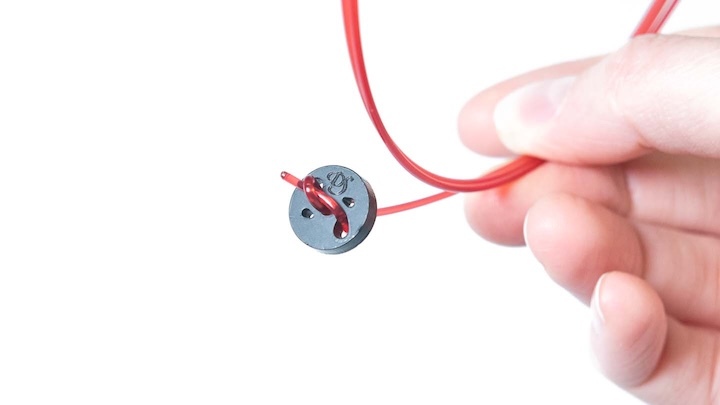

|

|

|
To all the harpists out there who have struggled with the harper's knot, Dusty Strings heard your cries of frustration, and are thrilled to share The Harper's NOT!
Tying the traditional knot with a slippery string and tiny spline is difficult or painful for many people, sometimes to the point of near impossibility, and that means a broken harp string can be a huge source of stress and anxiety. Dusty Strings attacked this problem at various points over the years, looking for a string anchoring method that would be easier on the hands, would be relatively simple to use, and would hold firm without causing string breakage or loss of tone.
- Larger than a spline
- Infinitely reusable
- Can be threaded in a simple pattern without the need for tightly pinching with your fingers
- Won’t spring apart midway through the knot
- Makes use of the mechanical power of the tuning pin to cinch down the knot
- Fits nylon and gut strings up to .080"/2 mm on any make of harp (see FAQ below for more details)
A pack contains 12 black String Buttons, an instruction card, a link to the video instructions on this page, and an extra, quick-reference instruction card that you can keep handy or pass on to a friend.
See the How To below for instructions. If you feel like being entertained, you'll enjoy the exaggerated spoof on an infomercial!
How to Thread String Buttons (see diagram photo)
1. Holding the String Button with the DS logo facing up, feed one end of the string up through the center hole. There should be about 3 inches of string sticking out on top of the button. The more length you leave here, the easier it will be to fasten the string, especially if it’s a thick string. Just make sure there’s enough string left on the long end to reach your harp’s tuning pin!
2. Feed the short end down through one of the tear-drop-shaped holes. (Each string button has a pair of large teardrops, which should be used with strings larger than .040” or 1 mm in diameter, and a pair of small teardrops, which should be used with strings .040” and smaller. If that’s too much to remember, just pick the smallest teardrop the string will fit through!)
3. Feed the short string end up through the opposite teardrop.
4. Tuck the short end through the loop on top of the string button. It doesn’t matter if you go front-to-back or back-to-front.
5. Hold the string button with one hand, and tug on the long string end to tighten. If you can’t cinch it all the way, don’t worry! Just leave a little less slack than usual when you put the string on your harp, and let the tuning pin do the work of pulling the knot tight.
6. If needed, use scissors or nail clippers to snip the short end of the string near the edge of the button. If left too long, the string tail can reach the soundboard of the harp and cause a buzz when you play.
Click here to download printable instructions
FAQs
Will new Dusty harps come with String Buttons? No. Dusty Strings get daily practice tying the harper’s knot in their workshop, and it is faster for them to do than using String Buttons. DS believes they are a great resource for many people, but they decided not to change how they string their harps.
Do they work with gut strings? Yes. String Buttons work with both nylon and gut strings, though see the next question regarding pedal gut.
Can I use these on my pedal harp or my lever harp with pedal gut strings (like the Boulevard)? Yes, but if you are looking for low-stress, DS recommend them only for the third octave and above. In their testing, strings in the fourth octave could be anchored with String Buttons, but it was not easy on the hands. With the heaviest strings (fifth octave), DS found String Buttons to be more difficult than the standard harper’s knot. In addition, strings thicker than .080” or 2 mm will not fit through the holes.
Why does it matter which way the logo faces? Because of the way the String Buttons are cut out and processed, there is a small chance that they could contribute to premature string breakage if flipped around. Make sure you can see the DS logo when you look in through the back of the harp!
How large are they? String Buttons are 1/2" in diameter and about 1/8" thick.
What are they made of, and do they buzz? String Buttons are made from black Delrin acetal, which is a hard plastic. Once the string is up to tension, the button is pulled so tightly against the back of the soundboard that it can't buzz. Just be sure to snip any long string tails!


